
Tips for Strip Piecing
Strip piecing is a wonderful way to piece more efficiently and without cutting and handling individual, fiddly squares. Accurately piecing long strips isn’t difficult, but it does require care. This guide will make sure that your strip piecing stays crispy and gorgeous from first cut to final product!
This post may contain affiliate links
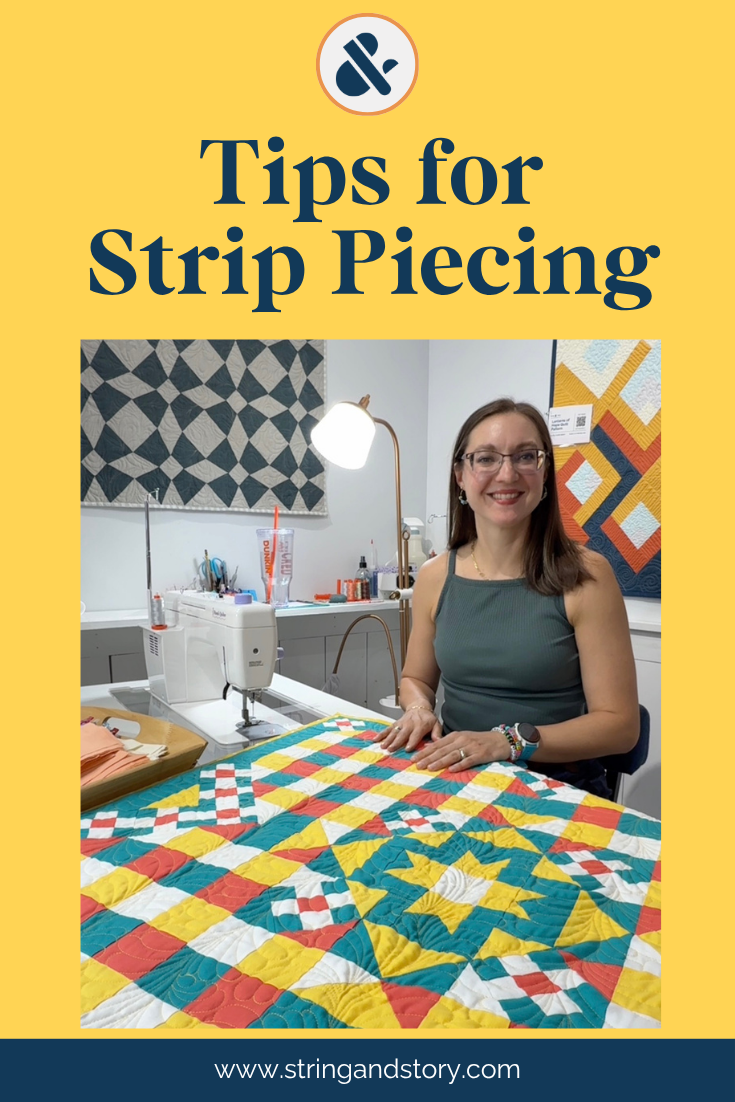
Piecing big, long strips can be a ton of fun– get the started under your presser foot and let ‘er rip! However, a bit too much of that can lead to bubbled, warped strips that affect the crispiness (accuracy) of your finished piecing. Fortunately, with the application of a few key techniques, you can have fun piecing, while still saving yourself from warped seams and fiddly squares.
Video
Cutting
Accurate piecing starts with accurate cutting, and for strip piecing that means making sure your strips are cut on grain and are equally wide all the way down– no wibble wobbles from funky folding or a wandering rotary cutter.
First, pay attention to the grain of fabric. If your fabric is fresh off the bolt, carefully fold the fold to the selvage to make the fabric a width that is easier to cut. When folding, lay the fabric flat, then bring the fold directly to the selvage, even if that means the raw, cut edge is uneven. You can square up the cut edge before proceeding.
For cutting, I strongly recommend using a Stripology XL ruler so you can cut multiple strips without moving either your fabric or your ruler. Every time you move your fabric or ruler you risk the fabric warping or mis-measuring. You can use paper tape to pre-math your cuts for any intervals not indicated on the Stripology XL, making it a breeze to slice through all your strips.
Piecing
I, probably like you, have known the pedal to the medal power of piecing strips at full speed while making a jelly roll race, etc. Heck, I once witnessed an actual RACE to piece a jelly roll race quilt top. As I mentioned, though, this is a surefire recipe for buckles and warps. Let’s prevent fabric distortion with a couple easy steps:
Quarter Inch Foot with a Guide: I’m not a big “quarter inch foot with a guide” kind of person, but if you have one, this is absolutely the time to use it. Strip piecing saves time, but after the first thrill, it can get kind of boring. Using a guide will ensure that your quarter inch seam stays even and accurate all the way down those long strips.
Pin: Long strips like to stretch, but stretched strips warp and wobble. Pin the two strips together at the end and work toward the center to make sure your strips are lined up properly
Alternate Sewing Direction: The pressure of the presser foot will cause the fabric grain to warp slightly with every seam, especially over a full width of fabric. If you sew all your strips together the same direction, you may end up with a slight parallelogram rather than a rectangle. You can mitigate this by alternating which end of the strip set you sew from so the seam movement is balanced.
Pressing
Fabric becomes more pliable when heated. It is what allows ups to press seams flat, but it can also contribute to warping. The debate around pressing versus ironing is probably as old as quilting itself, and this is a situation where avoiding drag on the is quite important. Lift the iron to moving it down the fabric rather than dragging it down the seam and distorting the fibers. Pay attention to how your strip sets will be sub-cut and pieced together to determine which way to press the seams so they will nest. On the final press before sub-cutting, I recommend using heavy starch so that you can cut across the seams without any warping.
Closing Thoughts
Strip piecing is a wonderful way to piece more efficiently and without cutting and handling individual, fiddly squares. Accurately piecing long strips isn’t difficult, but it does require care. Whether you’re making 9-patches, an Irish Chain, or an Around the World quilt, the techniques I taught you today will make sure your piecing stays accurate and crispy all the way through.